
Isolate
The selected section is isolated by closing the appropriate network valves, allowing the gel to be introduced and controlled within the main.

Remove iron, manganese and accumulated sediment with less water and less disruption.


Iron, manganese and sediment can accumulate on drinking-water main walls over time. Changes in flow can disturb those deposits, contributing to discolouration, turbidity complaints and repeated flushing activity.
On difficult legacy mains, particularly older lined cast-iron assets, conventional flushing can consume large volumes of treated water without providing sustained wall contact.
The gel is designed to fill the bore and 'wipe the walls' of the internal geometry, giving a controlled physical cleaning action while carrying captured material towards recovery.
It can offer a practical option where aggressive techniques cannot be used or where flushing alone does not provide enough contact with the pipe wall.
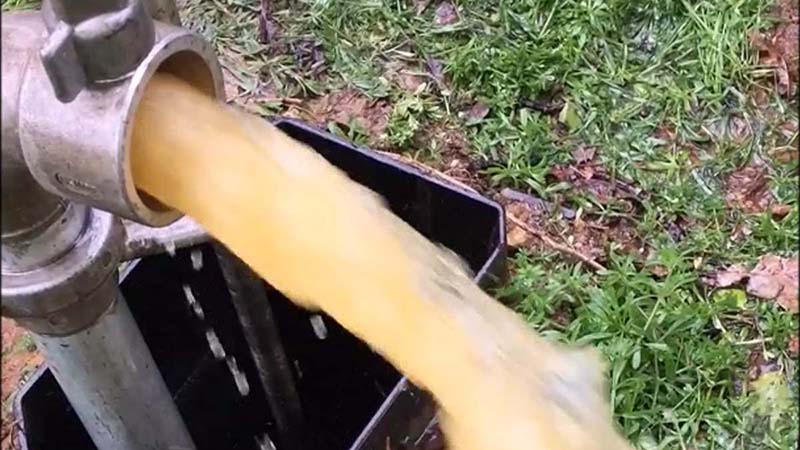
Gel cleaning provides controlled contact with the pipeline wall without relying on an aggressive mechanical cleaning action.
The selected section is isolated by closing the appropriate network valves, allowing the gel to be introduced and controlled within the main.
A viscous, conformable material provides a soft cleaning action rather than relying on a rigid mechanical pig.
Cleaning is designed around controlled contact with the pipe wall rather than aggressive scraping or abrasion.
The gel conforms to the internal geometry of the main, helping maintain contact across the complete pipe bore.
Loosened iron, manganese, sediment and other material can be entrained within the gel and carried towards the recovery point.
Targeted physical cleaning can reduce reliance on prolonged flushing with large volumes of treated drinking water.
Select the cleaning section and establish the operational window.
Introduce the prepared gel through a suitable hydrant access point.
Use controlled water flow to move the volume of gel through the main.
Maintain wall contact while entraining loosened deposits in the gel, capturing and locking in the particles.
Collect the gel and captured material at the next (or other) hydrant exit point.
Each clean is sized around the diameter, section length, pipe material, lining, available pressure/flow, access points, expected deposit loading and recovery route.
For live networks, the return-to-service plan, sampling requirements and local water-quality controls form part of the cleaning method.
Where a utility already has a planned isolation window, gel cleaning can potentially be integrated into that intervention so cleaning is completed before the main is returned to normal service.
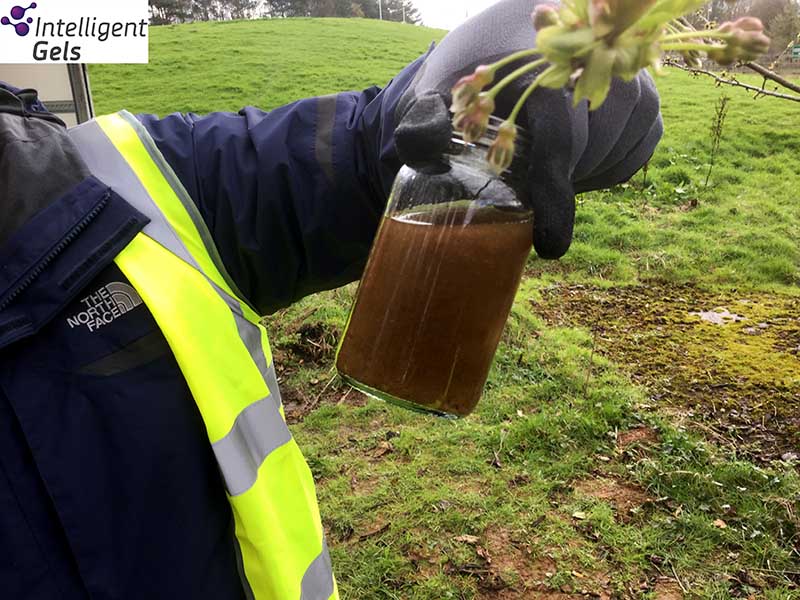
Gel cleaning provides a controlled way to remove accumulated deposits from drinking-water mains where conventional flushing may not provide sufficient wall contact.
The viscous gel conforms to the pipeline bore, captures loosened material and carries it towards a planned recovery point.
A 6-inch bitumen / coal-tar-lined cast-iron main had remained redundant and stagnant for more than 20 years. By the use of a viscous gel we produced substantial improvement across iron, manganese, turbidity and PAH indicators.
 99.1%Iron reduction10.57 → 0.094 mg/L
 90.5%Manganese reduction0.0884 → 0.0084 mg/L
 98.6%Turbidity reduction56.4 → 0.78 NTU
 99.4%PAH sum4 reduction4.99 → 0.030 µg/L
Send us the diameter, material, length, known deposit problem and available isolation window.


